









When discussing lighting control systems, the conversation often turns into a supposed choice between DALI or Casambi. Many planners and integrators assume that these two technologies represent competing approaches — one based on structured wired communication, the other built around wireless flexibility.
In reality, this is the wrong question.
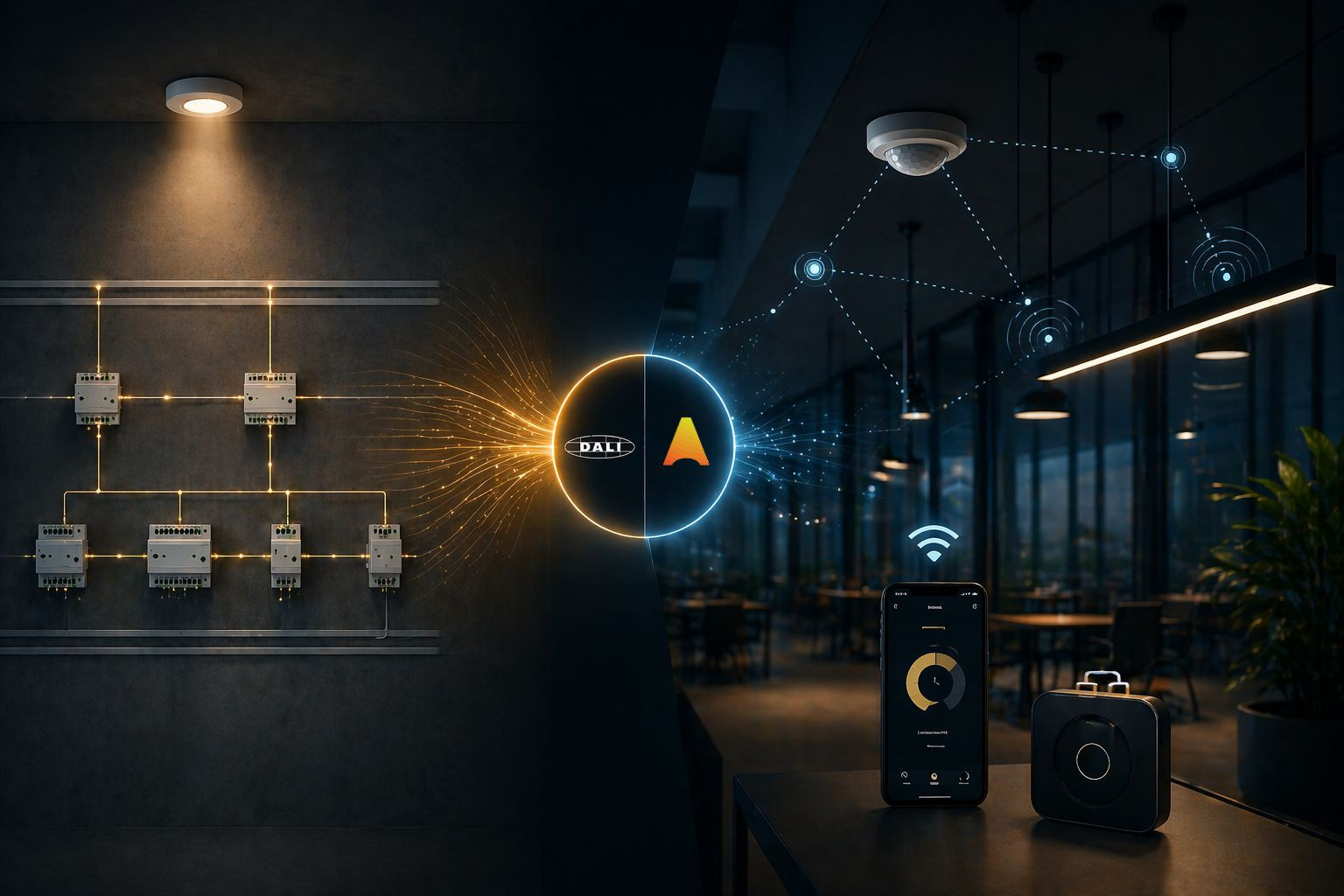
Modern lighting projects increasingly benefit from combining both systems. DALI, the established wired industry standard, provides reliability and a solid infrastructure, while Casambi, the leading wireless solution based on Bluetooth Low Energy, adds flexibility and easy integration where traditional wiring reaches its limits.
Rather than being contradictory, DALI and Casambi complement each other — and together they create a powerful and future-proof lighting control solution.
For many years, DALI (Digital Addressable Lighting Interface) has been an integral part of modern lighting systems. The protocol allows precise addressing and control of individual luminaires or groups, supports Tunable White (DT8) and color control, and ensures high reliability in commercial installations.
Especially in larger projects—such as offices, hotels, or public buildings—DALI impresses with its stability, compatibility, and the clear structure of the bus system.
Casambi, on the other hand, has established itself as the standard for wireless lighting control. Based on Bluetooth Low Energy, the system enables extremely flexible configuration, intuitive operation via app, and the integration of sensors, switches, and scenes—all without a central control unit.
Casambi is particularly suitable for retrofits, design applications, or dynamic lighting concepts where requirements change over the course of use.
The key point: DALI and Casambi are not mutually exclusive – they reinforce each other.
Casambi-enabled DALI interfaces or modules, such as the eldoLED Bluetooth DALI controllers (DT8) or Dalcnet Casambi DALI gateways, bridge the gap between the two worlds. They allow existing DALI infrastructures to be used while integrating the wireless flexibility of Casambi.
This means that a DALI-based installation can continue to enjoy all the advantages of the bus system – e.g., precise addressing and luminaire control – while Casambi adds modern features to the system:
The combination of DALI and Casambi is no longer a temporary solution, but a future-proof hybrid structure. It combines the reliability of a wired standard with the agility of wireless control.
For manufacturers, planners, and integrators, this means greater design freedom, less effort when making changes, and a technology that grows with the requirements of modern building automation.
