









Casambi sensor technology is not just about adding sensors to a lighting system. What really matters is how the logic behind those sensors is planned. In practice, the difference between a good solution and a frustrating one usually comes down to one thing: clarity.
In our webinar we focused on the practical factors that make Casambi sensor setups work reliably in real projects.
In many projects, the problem is not the hardware. The real issue is unclear control logic.
Typical problems include:
That is why sensor technology should always be planned from the user’s perspective first. The key question is not only which sensor is installed, but what the lighting should actually do in the space.
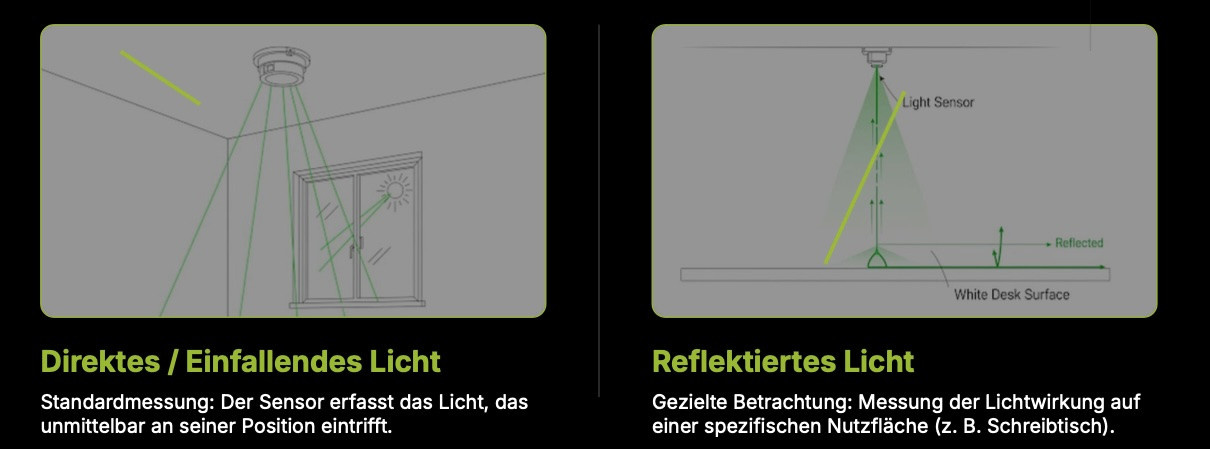
A key aspect of daylight sensing is the distinction between direct and reflected light. If the sensor measures the light at its own position, it is dealing with incident light. If the goal is to assess the lighting effect on a useful surface such as a desk, reflected light becomes relevant. This decision is not a minor detail. It defines the entire control strategy.
It is equally important to decide whether to work with closed loop or open loop control. Closed loop is suitable when a defined area or surface should be regulated consistently. Open loop makes sense when daylight input is detected without directly feeding back from the regulated zone. In both cases, one principle remains the same: the quality of control depends not only on the sensor itself, but on whether it is positioned in the right place to measure the right thing.
In Casambi, calibration, sensitivity, and tolerance play a decisive role. Calibration should only be done when it is clear what kind of light is actually being evaluated. Sensitivity influences how quickly the system reacts. Tolerance determines the threshold at which the system responds at all. The goal is not maximum automation, but a calm and plausible lighting response that users accept in everyday life.
This becomes especially relevant in rooms with uneven daylight conditions. With Daylight Gain and dedicated daylight sensors, the behaviour of individual luminaires can be differentiated intentionally. This allows luminaires near the window to respond differently from those deeper inside the room. At that point, simple sensor technology becomes a well-designed room logic.
A strategic perspective is also worthwhile when working with motion sensing. In professional applications, the goal is not simply to switch light on and off. What matters is the definition of clear states, for example between active and standby mode or between different scenes. Casambi makes it possible to map this logic flexibly and prepare it in a way that is easy to understand. The result is a clear state transition rather than a simple switching command.
A key factor in any lighting system is prioritisation. Automation should support the user. It should not create uncertainty about what the system is doing.
For this reason, a clear hierarchy between different control layers is essential:
Only when these levels are clearly structured does the system behave in a way that users can understand and trust in real operation.
Casambi sensor technology delivers the best results when measurement, placement, parameter settings, and control logic are planned together. That is what turns a technical installation into a practical lighting solution.
When the logic is right, the light does exactly what it should do. At the right time and in the right way.
